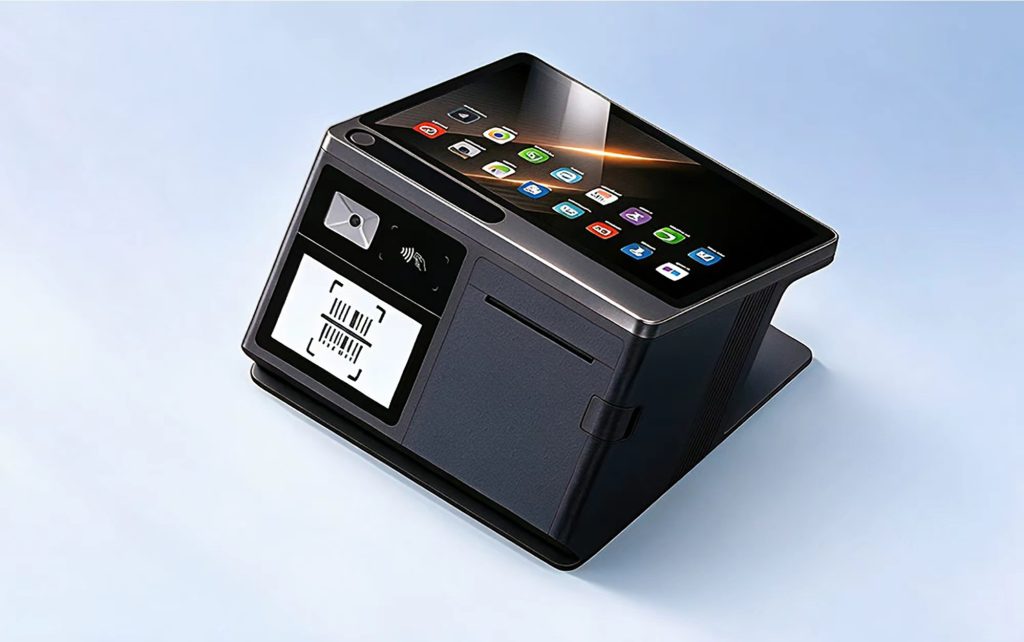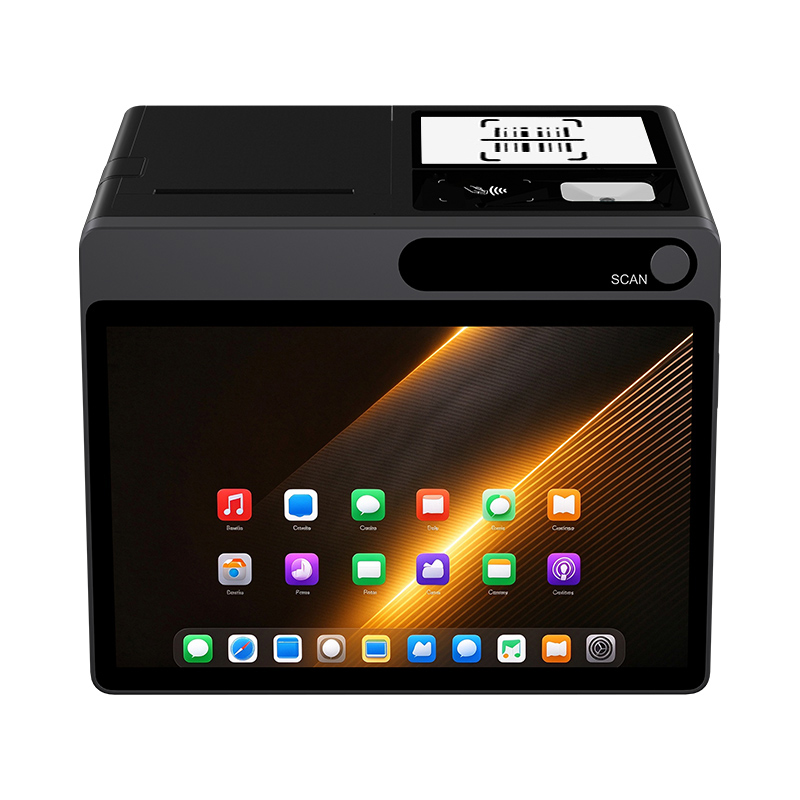


Short answer: If you run a shop in a UK village, farm, or coastal town, your Android POS tablet must support LTE Band 20 (800MHz) and Band 28 (700MHz APT) — these are the two frequencies that carry 4G into rural Britain. The NORYOX TPAD 11″ runs Android 14 with GMS certification, a full under-screen NFC stack, a 6000mAh battery rated for 8–10 hours, and 4G LTE connectivity — making it a purpose-built 4G LTE tablet for rural shop UK deployments where signal is weak and the nearest mast is miles away.
Why rural UK retail lives and dies by B20 and B28
If you’ve ever watched a payment fail because “the network dropped”, you already know the frustration. The truth is simple: most consumer tablets don’t support the frequencies that actually reach rural Britain.
LTE Band 20 at 800MHz is widely regarded as the primary rural coverage band across the UK. Its low frequency travels far and punches through thick stone walls — which is exactly why EE, Vodafone, and O2 all lean on it for wide-area coverage. A device that lacks B20 will genuinely underperform in rural deployments.
LTE Band 28 at 700MHz APT goes even further. Rolled out after the Freeview spectrum reallocation, it offers even longer range than B20 and is critical for the UK government’s Shared Rural Network — the programme aiming to bring 4G from at least one operator to 95% of the UK’s landmass. EE, Vodafone, and O2 have all deployed B28 in rural areas.
⚠️ The bottom line: a rural Android POS tablet with B20 B28 UK band support isn’t a “nice to have” — it’s the difference between taking a sale and watching the customer walk out.
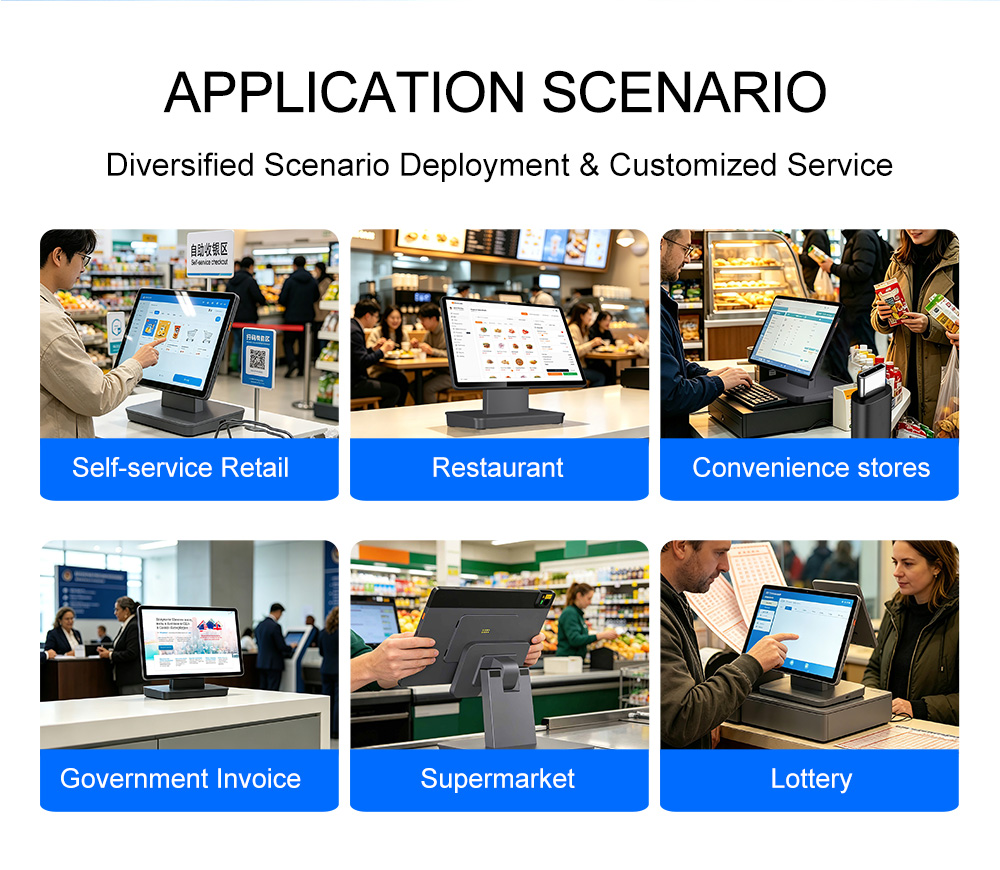
What to check before you buy a tablet for a village or farm shop
1. The LTE band list — read it line by line
Don’t trust vague marketing language like “4G enabled”. Open the spec sheet and look for an explicit band list. NORYOX’s Eurasian LTE band configuration includes:
LTE: B1 / 3 / 5 / 7 / 8 / 20 / 28 / 34 / 38 / 39 / 40 / 41
That single line covers every frequency used by all four major UK operators. B20 and B28 are both present. This is what makes a dual SIM tablet for rural retail UK deployment actually viable — you can run EE in one slot and Vodafone in the other, letting the device fall back automatically when one network’s signal fades.
2. Dual SIM — your insurance policy against dead zones
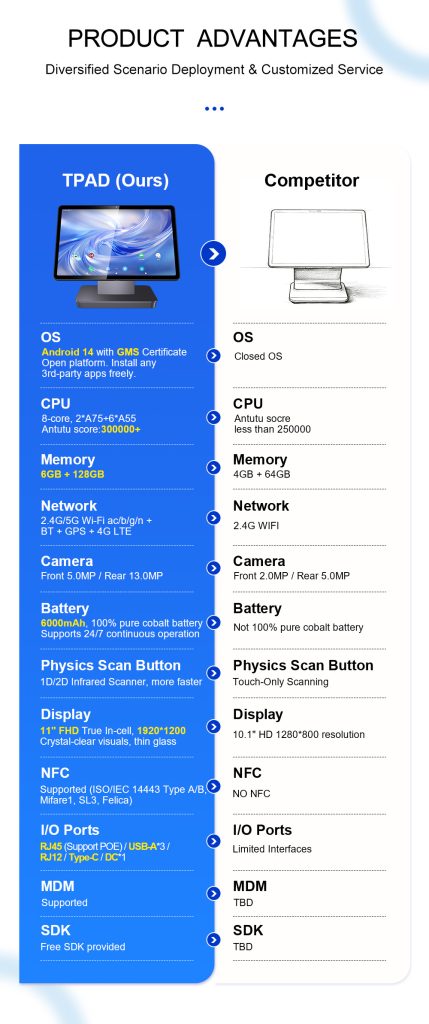
Rural coverage is patchy by nature. Even with B20 and B28, a single operator may have a blind spot right where your till sits. Dual SIM slots let you run two operators simultaneously. The TPAD 11″ accepts two SIM cards (or one SIM + one TF card), giving you network redundancy that a single-SIM consumer iPad simply cannot match.
3. Battery that survives a full shift
When you’re a village shop or a weekend farm stall, mains power isn’t always within reach. The TPAD 11″ carries a 6000mAh pure cobalt battery, rated for 8–10 hours of normal retail operation. That’s a full business day on a single charge — no hunting for a power socket mid-shift.
4. GMS certification — SoftPOS won’t run without it
Every mainstream UK SoftPOS app — Visa Tap to Pay, Tyl by NatWest, Phos, SumUp, Stripe — requires GMS certification to pass Google’s Play Integrity API checks. The TPAD runs Android 14 with full GMS certification and a hardware-backed keystore, so these apps install and run from Google Play without modification.
5. Full NFC protocol stack — for every kind of tap
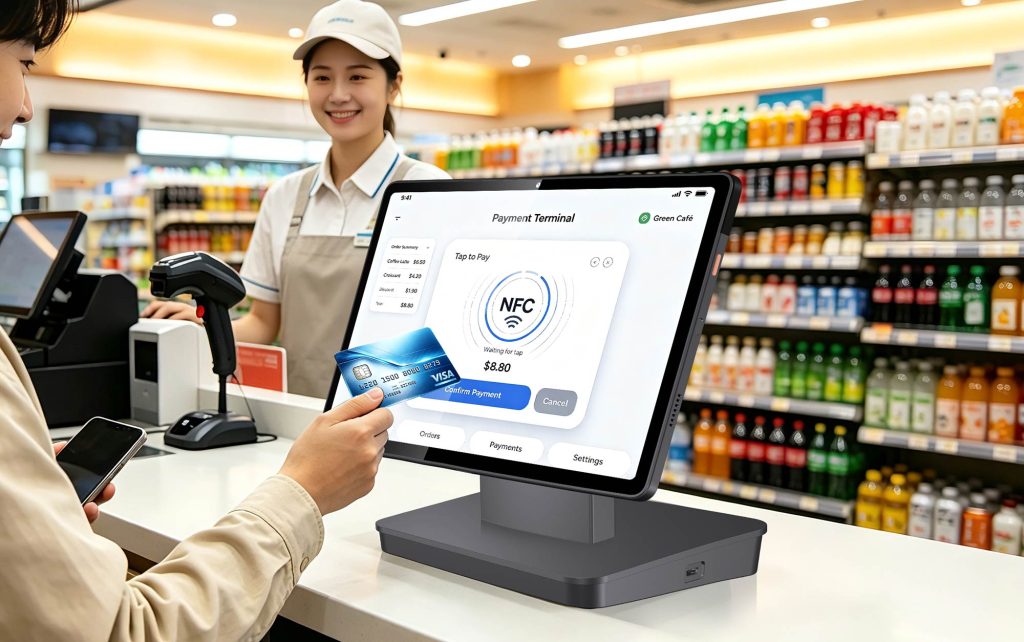
Rural shops serve everyone — locals with standard Visa/Mastercard, tourists with Apple Pay, and international visitors with Felica-compatible Suica cards. The TPAD’s under-screen NFC supports ISO/IEC 14443 Type A/B, Mifare1, SL3, and Felica — the complete protocol stack needed for rural SoftPOS connectivity.
How the TPAD 11″ performs in real rural scenarios
| Scenario | What happens with a consumer tablet | What the TPAD 11″ does |
| Village shop 5 miles from the nearest mast | Constantly drops to 3G or loses data entirely | B20 + B28 capture the distant signal; B1/3/5/7/8 add capacity |
| Single operator dead spot at the counter | Transactions fail during peak hours | Dual SIM auto-fails over from EE to Vodafone |
| 8-hour farmers’ market shift | Battery dies by mid-afternoon | 6000mAh lasts the full market day |
| Tourist taps a Japanese Suica card | Payment rejected — no Felica support | Felica-native NFC completes the sale |
| Need to scan loyalty cards + print receipts | Pair a Bluetooth scanner and a separate printer | Built-in 1D/2D scanner + USB-A × 3 + RJ12 + LAN built in |
Three rural deployments, one device
🏴 Scottish Highlands village store
A single-aisle shop 40 miles from Inverness runs a TPAD 11″ with EE in SIM Slot 1 and Vodafone in Slot 2. The device holds onto the distant B20 signal and switches operators seamlessly — no declined transactions, no awkward “try again” moments for customers.
🌊 Cornish coastal gift shop
Open seasonally from April to October. The nearest mast broadcasts B20 + B28 three miles inland. The TPAD captures both and aggregates them for the throughput needed to process summer tourist traffic — including Japanese visitors tapping Felica-supported Suica cards.
🚜 East Anglia farm shop
A working farm with a retail counter. Mains power is unreliable in the converted barn. The TPAD’s 6000mAh battery lasts the full Saturday market day; the built-in scanner handles QR codes for the farm’s loyalty programme; the under-screen NFC handles contactless payments from city visitors.
How to check which bands your local mast actually broadcasts
Before you commit, it’s worth verifying what’s available at your specific location. CellMapper.net is a free, crowd-sourced database of mobile network cell towers. Select UK, your operator (EE / O2 / Vodafone / Three), and LTE — then navigate to your shop’s location. Click on the nearest mast and you’ll see exactly which bands it broadcasts, including whether Band 20 (800MHz) and Band 28 (700MHz) are present.
If both appear — and they almost certainly will in any rural UK location — then a device with full B20 + B28 support is non-negotiable.
FAQ
Q: Does the TPAD 11″ support LTE B20 and B28?
A: Yes. NORYOX’s Eurasian LTE configuration includes B1/3/5/7/8/20/28/34/38/39/40/41. Both B20 and B28 are present, covering the full rural 4G spectrum used by EE, O2, Vodafone, and Three.
Q: Is B20 support enough, or do I really need B28 as well?
A: B20 is the minimum for rural UK 4G. B28 adds a second layer of low-frequency coverage and is being actively expanded under the Shared Rural Network programme. Having both gives you the best chance of maintaining a signal in the most remote areas.
Q: Can I use a normal iPad or Samsung tablet in a rural UK shop?
A: Most consumer tablets omit B20 and B28 to reduce costs. In a rural setting, they will frequently lose 4G data. For a full comparison, see our earlier piece: Can I Use a Normal Android Tablet as a POS Machine in the UK?
Q: How do I know which bands my local mast broadcasts?
A: Use CellMapper.net — select UK, your operator, and LTE, then navigate to your shop. Click the nearest mast to see its broadcast bands.
Q: Does the TPAD support dual SIM for rural retail?
A: Yes. The TPAD 11″ has two SIM slots. Insert an EE SIM in Slot 1 and a Vodafone SIM in Slot 2 — the device uses EE as primary and automatically fails over to Vodafone when EE’s signal drops below threshold.
Q: What are the SoftPOS connectivity requirements in rural areas?
A: Beyond B20/B28 band support and dual SIM, you need Android 12+ with GMS certification, a stable data connection (Wi-Fi or cellular), and a hardware-backed keystore. The TPAD 11″ meets all of these natively. For the full hardware checklist, see: NFC Protocols Required for SoftPOS
Q: Is the TPAD suitable as the best tablet for village shop payments?
A: For UK village and rural retail, the TPAD 11″ addresses the exact challenges — distant masts, single-operator dead spots, all-day battery life, and full NFC for every payment type. It’s designed for precisely this environment.
Conclusion
Choosing a best tablet for village shop payments isn’t about buying the cheapest Android device with an NFC chip. It’s about matching the exact LTE bands that carry 4G into Britain’s villages, farms, and coastal communities. Band 20 (800MHz) and Band 28 (700MHz) are non-negotiable. Without them, your SoftPOS will fail precisely when you need it most — during the lunch rush, the weekend market, or the height of tourist season.
The NORYOX TPAD 11″ is built with rural realities in mind:
- Full Eurasian LTE band support including B20 and B28
- Dual SIM for automatic network failover
- 6000mAh battery rated for 8–10 hours of real-world retail use
- Android 14 with GMS certification for every UK SoftPOS app
- Complete NFC protocol stack (ISO 14443 A/B, Mifare1, SL3, Felica)
- Built-in 1D/2D scanner and rich I/O (3× USB-A, RJ12, LAN)
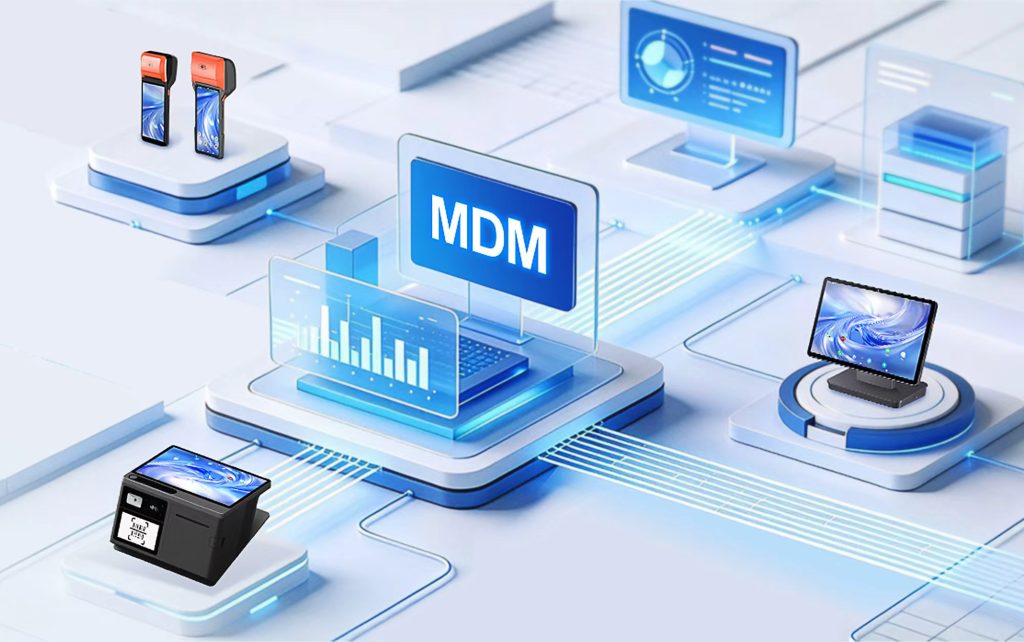
- MDM support for multi-store rural deployments
It’s not a consumer tablet with a payment app bolted on. It’s a purpose-engineered 4G LTE tablet for rural shop UK operations — SoftPOS-ready out of the box.
Ready to deploy reliable SoftPOS in your rural UK retail location?
📧 liujuan@sznyx.net